
A research team from Nanyang Technological University and Hefei University of Technology has introduced DragNeXt, a breakthrough in drag-based image editing that changes how we interact with AI-powered photo tools. Unlike older methods that require clicking on tiny points, DragNeXt lets users drag entire regions to reshape, rotate, or move objects naturally. This new approach solves long-standing problems with blurry edits, misaligned movements, and slow processing speeds that have frustrated both casual users and professional designers.
Drag-based image editing has become one of the most exciting features in modern AI art tools and photo editing software. It allows users to manipulate images by simply dragging objects to new positions, making it feel like magic. However, current tools like StableDrag and FastDrag still rely on point-based systems that create confusion. When you want to move a hand in a photo, these tools ask you to mark specific points, but they often guess wrong about what you actually want to do. This leads to distorted shapes, unwanted background changes, and results that do not match your creative vision.
Two major problems have held back drag-based editing from reaching its full potential. First, traditional point-dragging is highly ambiguous. The system cannot clearly understand whether you want to move an object, resize it, or rotate it. Second, existing methods use a back-and-forth process of motion tracking and supervision that feels clunky and produces low-quality results. These issues cause blurry textures, lost details, and editing failures that waste time and ruin creative projects.
To overcome these challenges, the research team rethought the entire editing process from the ground up. They treated drag-based editing as a Latent Region Optimization problem, or LRO for short. Instead of fighting with individual points, DragNeXt works with whole regions and understands geometric changes like translation, rotation, and scaling. This means when you drag a cat’s head to turn it, the system knows you want rotation, not just a simple shift. This region-aware approach eliminates the guesswork and aligns perfectly with what users actually intend.
Paper link: https://arxiv.org/pdf/2506.07611
Code repository: https://github.com/zhouyuan888888/DragNeXt
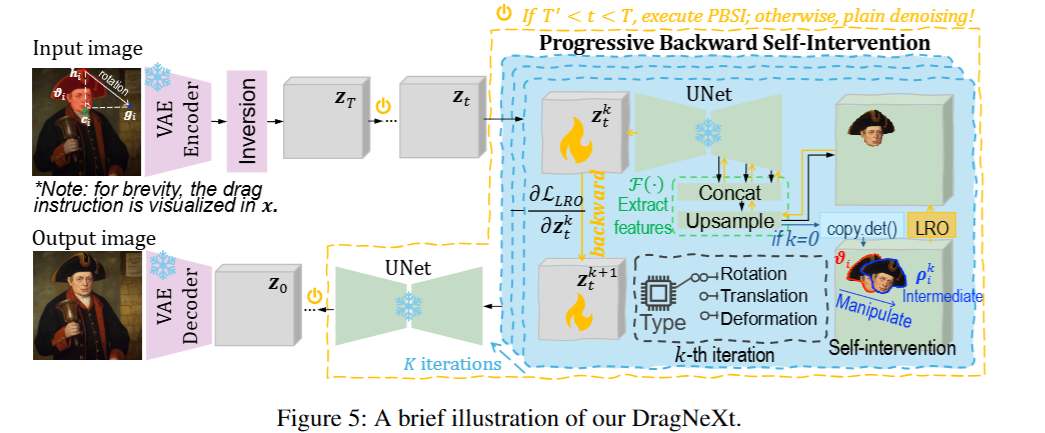
The core idea is simple but powerful. DragNeXt transforms complex image changes into clear geometric tasks. By specifying both the area to edit and the type of transformation needed, users get precise control without the headaches of point-based systems. The method also introduces a new technique called Progressive Backward Self-Intervention, or PBSI. This clever approach uses information from intermediate drag states to guide the editing process, making results sharper and more natural while keeping the workflow simple and fast.
DragNeXt brings three major improvements that set it apart from every other tool on the market:
First, the Latent Region Optimization framework finally answers the what and how questions that have plagued drag editing. By treating user instructions as region-level geometric transformations, it removes the ambiguity that causes so many editing failures. You no longer need to wonder if the AI understood your drag correctly.
Second, the Progressive Backward Self-Intervention method leverages structure information at the region level and guidance from intermediate states. This produces crisp details, preserves textures, and maintains natural shapes. The system also uses KNN-based acceleration to speed up the process dramatically without sacrificing quality.
Third, DragNeXt moves beyond the old point-based mindset. It focuses on local regions within images while tapping into global structure information. This dual attention to detail and big-picture context makes edits both stable and accurate, opening new creative possibilities that were impossible before.
Experimental Results
The research team tested DragNeXt on challenging tasks including 2D and 3D rotation, complex dragging, and shape changes. The results are impressive. In one test, users rotated a cat’s head around its cheek as a pivot point. In another, they changed a cup’s position while keeping its exact shape intact. These fine-grained edits are extremely difficult for current tools but come naturally to DragNeXt.
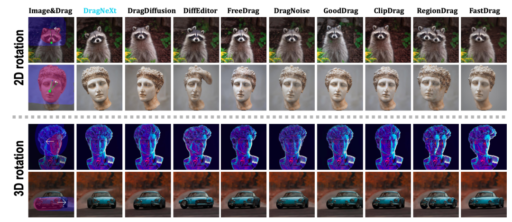
In crowded scenes with multiple objects like a platform stage or scattered rocks, DragNeXt showed remarkable stability. It accurately located target objects while keeping background details consistent. Unlike other methods that lose fine features or distort shapes, DragNeXt preserved every detail. For 3D rotation tasks, the system used a pretrained diffusion model to create more natural out-of-plane rotations, a task where traditional methods often struggle.
The team also conducted a user study with 26 participants comparing DragNeXt against four leading methods: ClipDrag, RegionDrag, FastDrag, and the classic DragDiffusion. Across multiple dimensions including editing accuracy, result quality, and user preference, DragNeXt won decisively. An overwhelming 84 percent of participants preferred DragNeXt’s editing results, proving that the method delivers not just technical improvements but real user satisfaction.
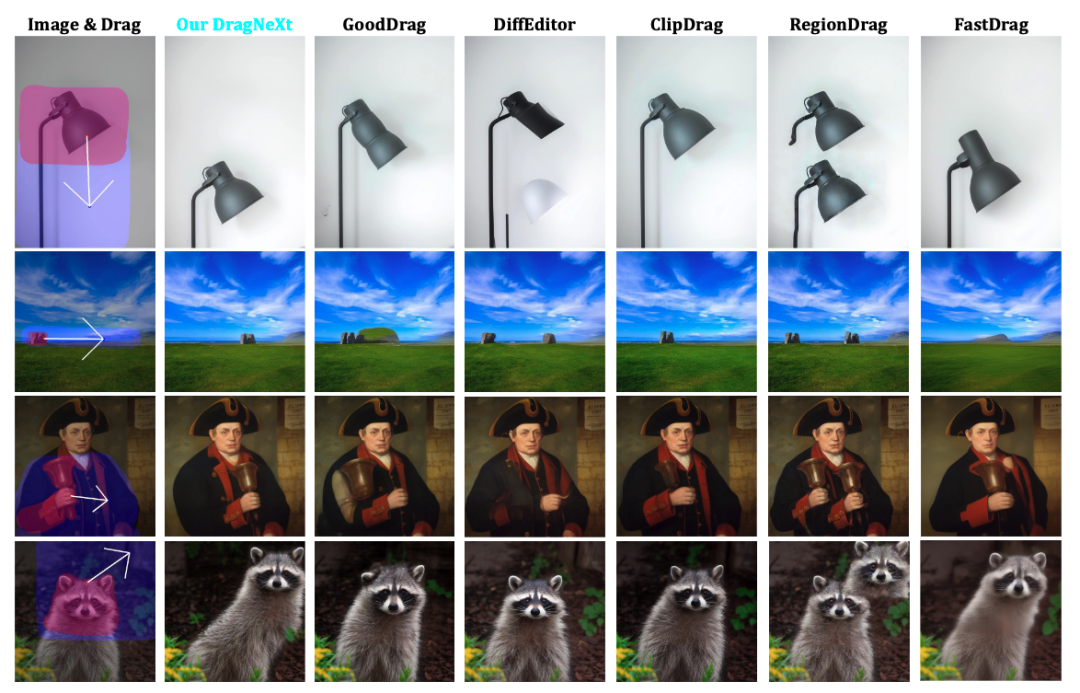
DragNeXt editing results in challenging drag scenarios
cuck chat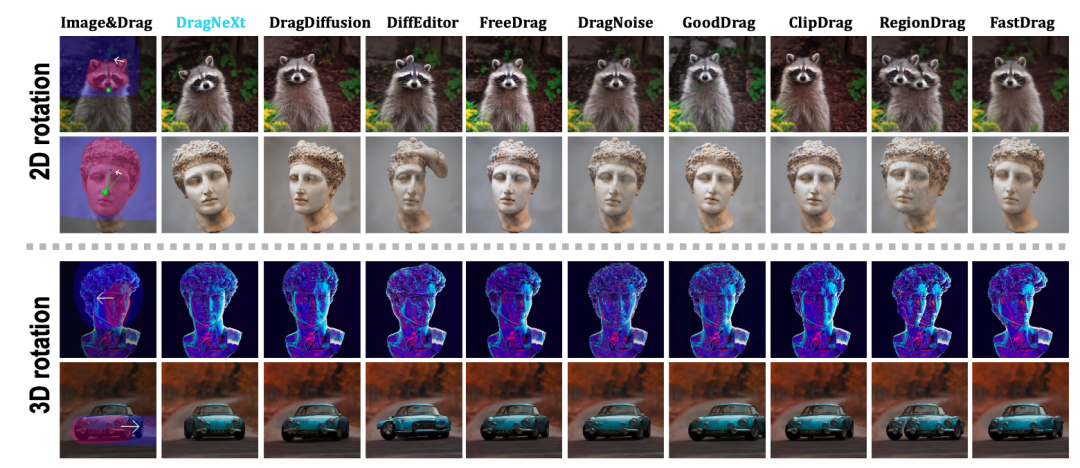
DragNeXt editing results in 2D and 3D rotation tasks
Looking deeper at what makes DragNeXt special, three technical strengths stand out:
One,girlfriend gpt the method achieves precise drag alignment by using geometric transformations and region-level instructions. This captures the true meaning behind user drags, making the editing intent clear and unambiguous.
Two, editing quality reaches new heights by combining region structure information with progressive backward self-intervention. This eliminates distortion, preserves shadows and textures, and keeps fine details from disappearing. The results look naturally edited rather than artificially processed.
Three, efficiency and flexibility improve through KNN-based acceleration and a simplified optimization process. The system handles short and long drags with equal stability, and it performs consistently across 2D shifts, 3D rotations, and shape transformations. This versatility makes it a reliable tool for diverse creative needs.
The research also reveals important insights about drag accuracy, editing quality, background changes, and efficiency trade-offs. These findings offer a complete picture of how drag-based editing works and where future improvements can happen. The method successfully balances speed and quality, solving a problem that has long divided the field into fast-but-rough tools and slow-but-accurate ones.
Looking ahead, the team plans to expand DragNeXt in exciting directions. They want to support more transformation types like twisting, bending, and stretching, which would unlock entirely new editing possibilities. They also aim to combine drag-based editing with layout-to-image generation, allowing users to specify both position and appearance changes in one workflow. Another goal is to speed up the process even further by exploring attention mechanisms within diffusion models. These advances could make drag-based editing as fast and natural as drawing with a pencil.