

[Featured Story] In 2023, Stanford’s “AI Town” went viral, and many similar projects followed. But all of them shared one common bottleneck — the world was hand-built and fixed. Recently, a solo developer spent his 10-day honeymoon sprinting on a project called WorldX: type one sentence, wait five minutes, and a complete AI world is born — with maps, characters, animations, and personalities all generated automatically. AI characters live, talk, form memories, and create dramatic emergent behavior entirely on their own.
Type this sentence: “A bustling night market in the Song Dynasty, with a pawnshop owner, a fortune teller, a police officer, a thief, a drunkard, and an influencer who just time-traveled from the modern day.”
Five minutes later, a finely drawn map of a Song Dynasty night market appears before you. The pawnshop, the fortune-telling stall, and the Buddha statue each sit in their place.
Then six characters start moving on their own —
The pawnshop owner guards his counter, muttering about being robbed. The fortune teller waits for customers. The police officer patrols around, gathering clues. The thief blends in as an ordinary passerby. The drunkard staggers from one end of the street to the other. And that time-traveling influencer — with flowing hair and clothes that stand out from everyone else — is being curiously stared at by all.

No one wrote a script.
Everything that happens next is entirely decided by the AI characters themselves. The police officer might question everyone. The thief might approach the officer to test the waters, then suddenly feel exposed and try to slip away. The fortune teller might grab the influencer and say “your forehead looks dark.” The drunkard might knock over the pawnshop sign and start a fight.
This is a truly “living” AI world.

Project link: https://github.com/YGYOOO/WorldX
Technical breakdown: https://zhuanlan.zhihu.com/p/2032410449854068566
 AI Towns Have Been Hot for 3 Years But No One Solved “World Building”
The story starts in 2023.
That year, Stanford released the famous Generative Agents paper — 25 AI characters living, socializing, and forming memories in a virtual town, showing stunning “emergent behavior.” The concept of “AI Town” exploded overnight and ignited the entire Agent research field.
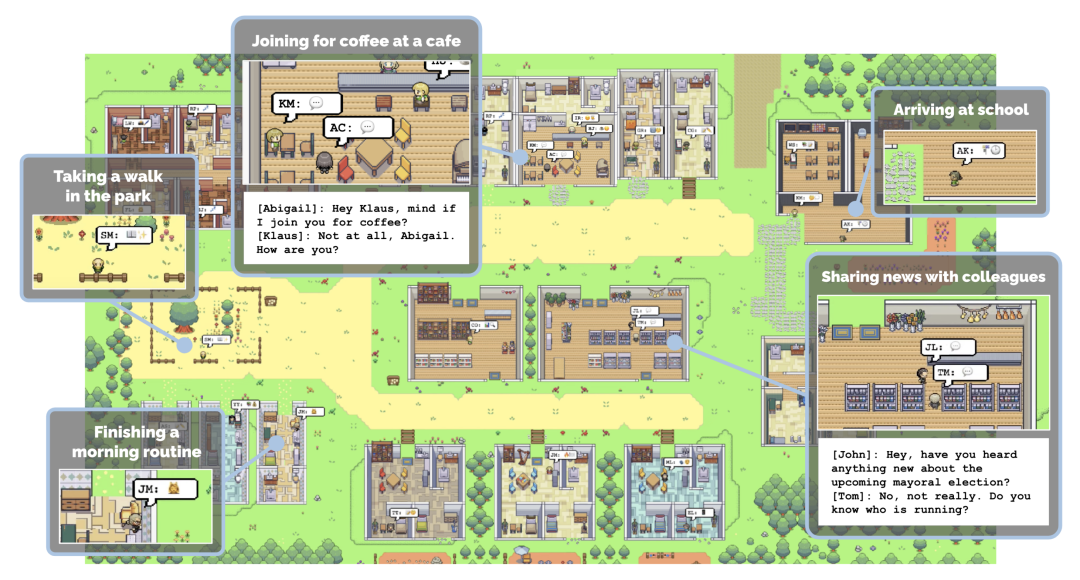
In the three years that followed, similar viral projects kept popping up — ai-town, Microverse, AgentSims, TinyTroupe — all trying to recreate and expand on this idea.
But every single one of them shared the same bottleneck:
The world was hard-coded.
Maps had to be drawn by hand. Characters had to be configured one by one. Scene interactions had to be scripted line by line. Want to switch to a “cyberpunk noodle shop” or “post-apocalyptic convenience store” setting? Sorry, start from scratch.
The academic world noticed this too. Shengda AI Research Institute, Shanghai AI Lab, and others jointly published “World Craft” (arXiv 2601.09150) trying to solve it — but the paper itself admits: current systems only support indoor scenes (homes, offices, single-building interiors). They do not support streets, plazas, or open worlds. And the map style is highly uniform — all standard RPG pixel art assembled from a 5,500+ asset library.
Truly “create any world from any sentence” — no one had done it yet.
Until WorldX came along.
 One Sentence One World: The 5 Minute Magic
WorldX makes this so simple it feels impossible.
All you need to do is type:
hentai ai generator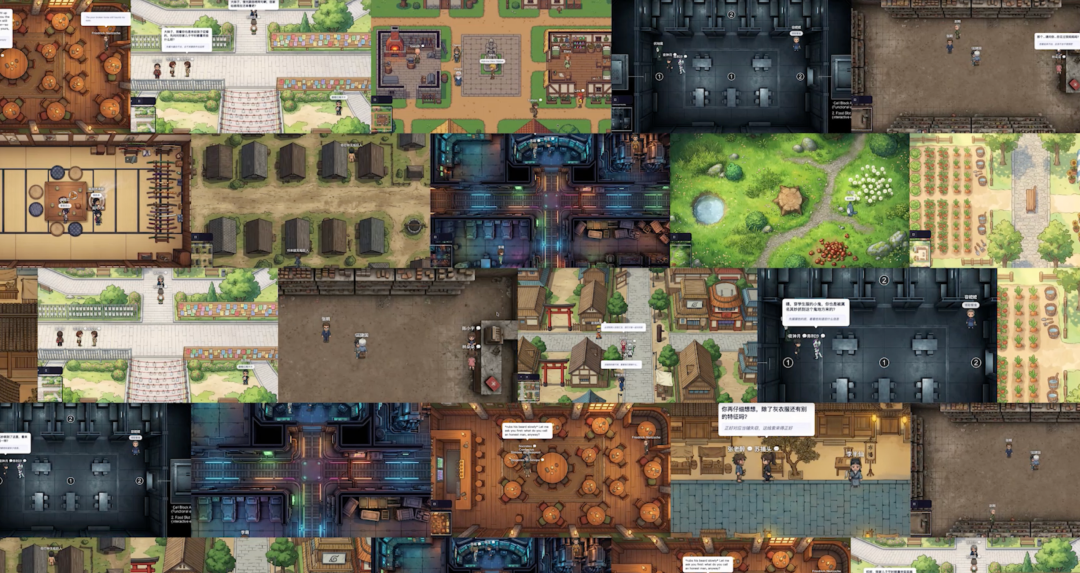
Five minutes later, a complete world with art style, character portraits, animations, and full running logic appears before you. Every world is generated from scratch. No templates are reused.
And here is the key — generation is just the beginning.
After entering the world, you will see:
And you? You are the “god” of this world.
You can:
ai hentai chat
Even more impressive, WorldX has a multi-timeline plus history replay system — the same world can branch into multiple timelines, letting you see if the same starting conditions lead to the same ending. Any segment of history can be replayed like a video recording, so you never miss a “highlight moment.”
The Hardest Challenge: Making AI Understand Its Own Maps
The author himself made a list of “blocker problems” — each one capable of killing the entire project. Here is one example:
How do you make the code precisely know which areas in an AI-generated map are walkable?

This looks simple — a human can tell at a glance where you can walk and where there are trees or roofs. But making code know this means you need exact pixel coordinates. And maps generated by text-to-image models are essentially just “pictures” — no layers, no labels, no coordinate data.
The most obvious approach was to use a multimodal large model (like Gemini 3 Pro) to look at the image and return coordinates. The author tested this and found it completely unworkable — VLM output pixel coordinates had massive errors. Ask the same image twice and you get wildly different answers.
This is the fundamental limit of large models: they are trained to understand image content like humans, not to act like measuring tools — humans cannot eyeball exact coordinates either.
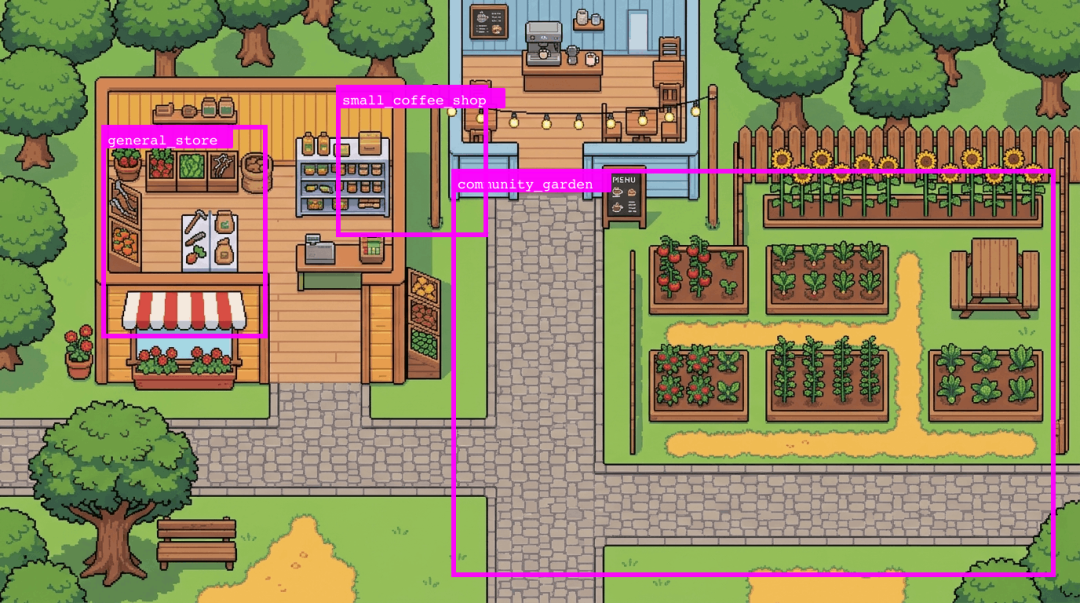
What about adding grid lines? The author tried that too — overlay reference lines on the image, then have the VLM use the grid to locate positions, with a self-review loop to keep correcting. It worked, but only barely for small targets like buildings and interactive objects. For large irregular areas like “walkable zones,” it was almost unsolvable.
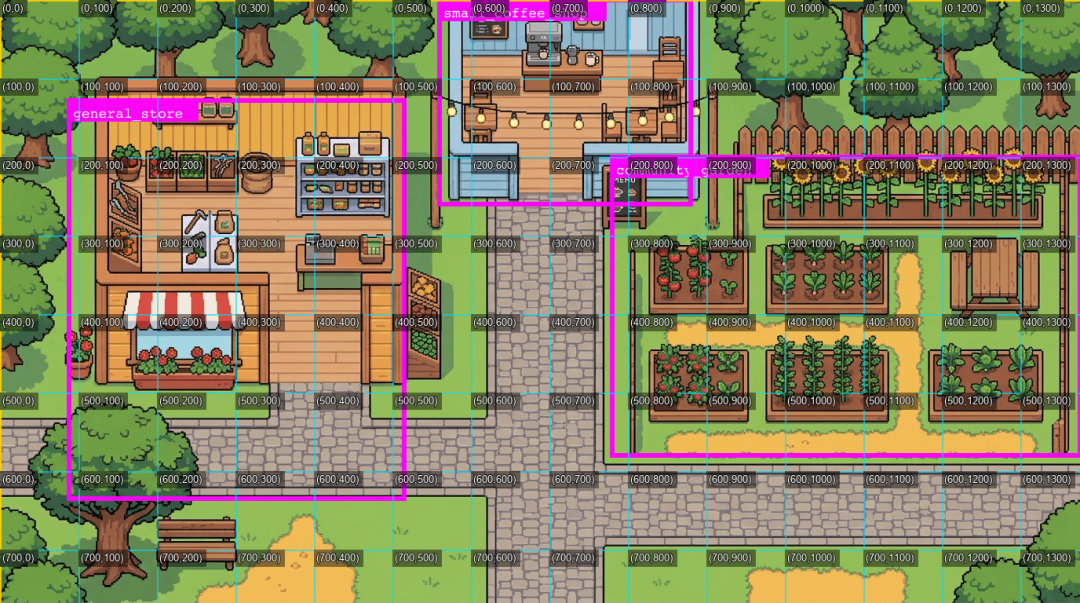
In real game maps, “walkable areas” might be made of hundreds or thousands of 16x16px tiles. Asking a large model to label them one by one? You would burn through your token budget in no time.
The author even asked every top model one by one. None could offer a workable solution.

The Spark of Inspiration: Let AI Paint, Let Code Calculate
The turning point came from a moment of “perspective shifting” — if a real person had to mark all walkable areas on a map, what would they do?
They could simply take a marker and color the walkable areas. Even a child can do this.
Then, by doing a pixel-level color difference comparison between the “before” and “after” images, you can precisely calculate the coordinates of all colored areas. If a pixel changed color, it was painted. If not, it was not. At the code level, this is a fully deterministic calculation that does not rely on any AI.
So the question becomes: can AI do the coloring?
The answer: yes.
And the tool that can do it is the same kind used to “draw the map” — a text-to-image large model.
The author used the text-to-image model as a “vision tool” — feeding the original image as reference, and having it overlay all walkable areas with semi-transparent cyan.
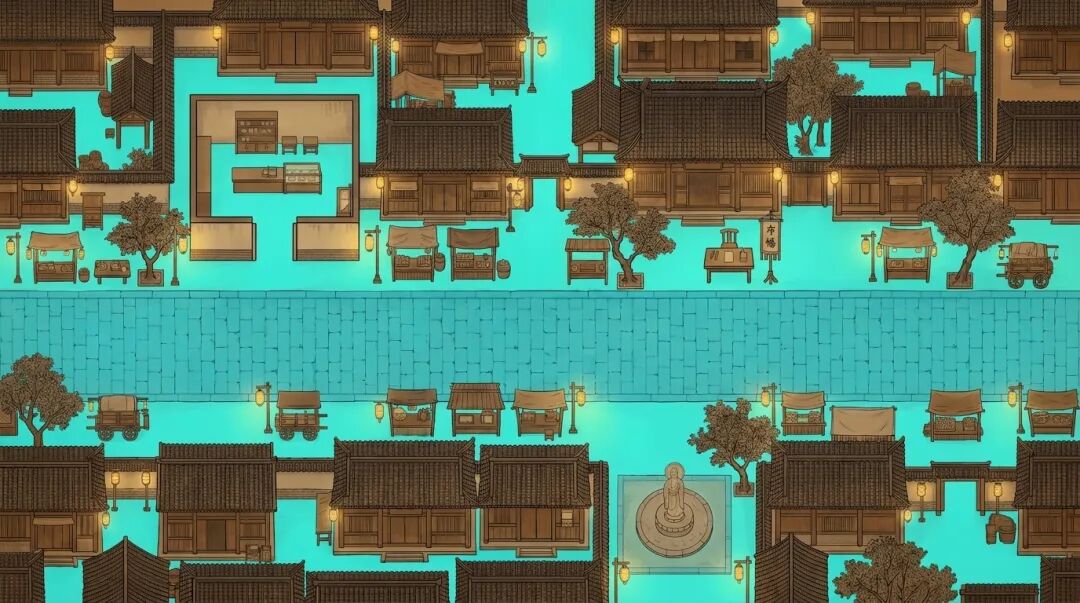
Then a fixed piece of code compares the two images tile by tile, detecting cyan color shifts:
Strong evidence: delta G is greater than or equal to 18 AND delta B is greater than or equal to 18 AND delta R is less than or equal to 8
Weak evidence: delta G is greater than or equal to 10 AND delta B is greater than or equal to 10 AND delta R is less than or equal to 14
This yields a precise walkable grid.
This is one of WorldX’s key innovations — “overlay labeling plus difference localization.”
It splits the problem in half: let AI do what it is good at (painting the location), and let CV algorithms do what AI is bad at (calculating exact coordinates). The uncertain output of generative AI is transformed into deterministic CV computation. This is the key that makes the entire pipeline run stably.
Interestingly, just days after WorldX went open source, Google DeepMind published the Vision Banana paper (arXiv:2604.20329), systematically validating the core insight that “image generation models naturally possess strong visual understanding and can output segmentation, depth estimation, and other visual tasks through color encoding.”
WorldX independently arrived at the same direction in engineering — instead of having a VLM directly report coordinates, use an image editing model to paint, then extract precise coordinates through color difference. This perhaps shows that the intuition behind this path is correct. Of course the specific implementations differ: Vision Banana requires instruction fine-tuning, while WorldX is a zero-shot pure engineering solution.
Multi-Color Separation Plus Self-Review: Turning the Impossible into Stable Reality
The walkable area problem was solved. But there was a related issue — when a map has multiple different functional zones (pawnshop, fortune-telling stall, Buddha statue), how do you know which color block corresponds to which?
Simple: use different colors. Pawnshop gets red, fortune-telling stall gets blue, Buddha statue gets yellow — classify by color during difference localization.
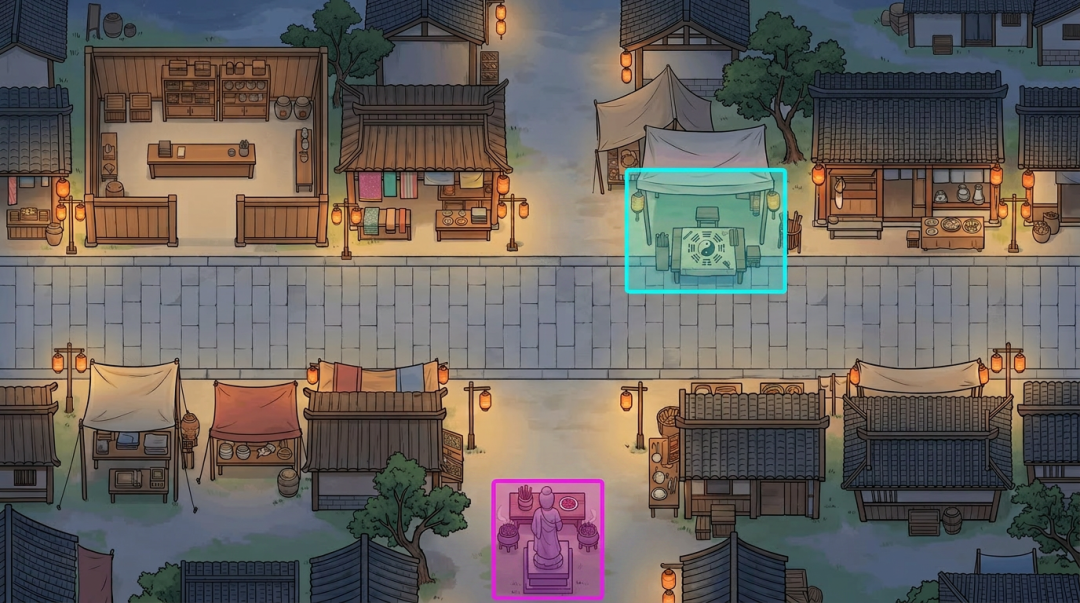
To avoid too many colors causing the model to get confused, the author limited each round to labeling at most 4 elements, processing in batches.
Then there is another design — self-review plus constraint accumulation:
After each round of map or label generation, the system sends results to a visual review LLM for structured review. If it fails, the feedback is not treated as a reason to “start over” — instead it is converted into Chinese constraints and appended (not replaced) to the next prompt.
Each round of generation “remembers” previous lessons. Constraints become more and more precise. The whole process converges like a funnel.
This mechanism runs through the entire generation pipeline — from map generation to functional zone localization, interactive object localization, and walkable area labeling. Every step has a “generate → review → inject constraints → retry” loop.
The entire map generation pipeline has six steps:

Running the whole pipeline, the author kept token costs at a very manageable level (generating one world takes about 30,000 to 180,000 tokens) — he wrote something touching in his blog: “I hope this can eventually become an accessible architecture that everyone can use. With big model providers constantly raising prices, adding rate limits, and cutting features, this only strengthens my commitment. Of course, another reason is that I do not have enough money.”

How Do AI Characters “Come Alive”? Tick Loops, Three-Layer Memory, and Two-Dimensional Emotion
Once the world is generated, the server loads the config and the simulation engine starts. From this moment on, all character behavior is fully driven by AI.
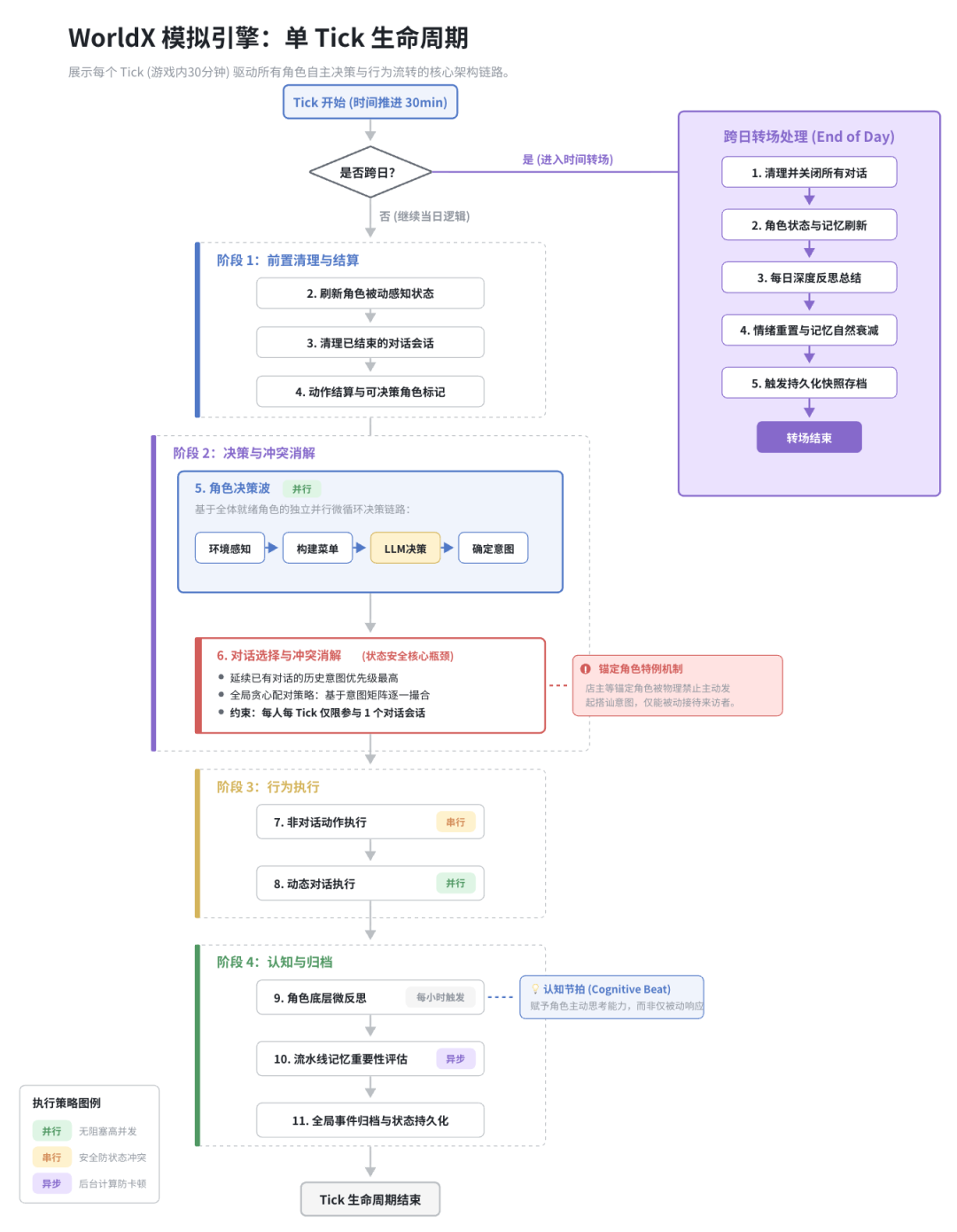
The engine runs on “Ticks” as its basic time unit (default: 1 Tick = 30 minutes in-game time). Inside each Tick is a carefully choreographed flow:
For the memory system, the author used a transparent four-dimensional weighted scoring:
score = relevance times 3 + recency times 2 + importance times 2 + emotionalIntensity times 1
Why not use a vector database?
The author’s explanation is refreshingly simple: in this kind of Agent system, debuggability matters more than precision. Characters “always forget important things”? Raise the importance weight. “Always stuck in the past”? Raise the recency weight. The weights are transparent. Change them and you can verify immediately. Vector databases are a black box in this scenario.
Memory also has a full life cycle — decay, consolidation, and elimination. Frequently recalled, emotionally intense, and important memories get consolidated into long-term memory. The rest gradually fade.
“Humans forget too. Yet this is not a bug — it is a super feature. Proper forgetting is the precondition for memory iteration and reorganization. It is the compression, understanding, and generalization of information,” the author wrote in his blog.
Emotion uses a two-dimensional model — Valence (pleasantness) plus Arousal (activation level) — which can express far richer emotional states than single labels: excitement, anxiety, calmness, anger. Emotions are only visible to other characters when they “clearly fluctuate,” avoiding the unreal feeling of “everyone being an emotional open book.”
 Comparison with Stanford’s Generative Agents
“Generative Agents proved that ‘AI characters can produce interesting social behavior.’ WorldX goes one step further and answers ‘how to let anyone own their own AI world with just one sentence.'”
A Developer’s 10-Day Honeymoon Sprint
Finally, here is something deeply impressive — this entire project was built by one developer during his 10-day honeymoon.
Disclaimer: This project was built by me during my 10-day honeymoon through vibe coding. Time was truly limited, and there are many points for optimization that will be implemented later.
Ten days. From zero to a working “one sentence one world” system. Including:
This is perhaps what vibe coding truly changes — allowing a solo developer, in their spare time, to build what used to require an entire team.
Future Directions: Immersive Worlds, World Corridors, Visual Novels
The author listed several exciting directions:
Closing Thoughts
At the end of his article, the author left a deeply philosophical passage that I cannot help but share here:
“Today, we can already create a small, somewhat intelligent ‘mini virtual world’ with just one sentence. As model capabilities keep growing, the worlds we can generate will become increasingly close to reality. Are we ourselves inside a virtual world? Once humans truly create a virtual world indistinguishable from reality, and the people in that world gain consciousness, then the probability that we ourselves are in a virtual world immediately becomes infinitely high — because recursive creation goes on forever. Though at that point, ‘virtual’ would essentially be ‘real,’ wouldn’t it?”
We are still far from that recursive universe. But before that, a nearer future may arrive first — where everyone owns their own virtual world, lives in it, and lives the life they want. As natural as everyone today having their own social media feed and short video account.
At that point, the way we look at entertainment, companionship, and content may all be quietly rewritten. What WorldX is doing now is the beginning of that story.